


Pet owners in Etobicoke and across the Greater Toronto Area tend to think of fleas and ticks as a summer nuisance. Something you deal with when the weather warms up, and forget about once the leaves fall. That assumption used to be close enough to the truth. It no longer is.
Ontario’s tick population has been expanding steadily for over a decade, and the data from recent years makes the trend impossible to ignore. South Etobicoke Animal Hospital has seen a noticeable increase in tick-related cases over the past several seasons, and the patterns we are seeing in clinic line up with what provincial health authorities are reporting across the board. Flea infestations, meanwhile, remain a year-round problem in homes with central heating, catching owners off guard in months they assumed were safe.
This guide walks through what Ontario pet owners actually need to know about flea and tick prevention for dogs and cats, including the seasonal risk windows that matter, the prevention options your veterinarian may recommend, and the mistakes that lead to preventable infestations and tick-borne disease exposure.
Why Ontario’s Parasite Landscape Has Changed
Ontario is not the same tick environment it was ten years ago. The blacklegged tick (Ixodes scapularis), the species responsible for transmitting Lyme disease, has expanded its range significantly across the province. According to Public Health Ontario’s vector-borne disease surveillance data, the entire Greater Toronto Area now falls within an established blacklegged tick risk zone. That includes Etobicoke, Mimico, Long Branch, Mississauga, and every municipality bordering Lake Ontario.
The numbers reinforce what the maps show. Ontario recorded over 3,100 confirmed Lyme disease cases in 2025, a 33 percent increase over the previous year. The case rate per 100,000 residents has climbed from less than 1 in 2010 to over 23 in 2025. That is not a subtle trend line.
Several factors are driving this shift:
- Warming winters. Blacklegged ticks are active on any day the temperature rises above 4 degrees Celsius. Milder winters mean longer active seasons and better overwinter survival rates for tick populations.
- Geographic expansion. Tick populations are moving northward at an estimated 35 to 55 kilometres per decade, carried by migratory birds and expanding deer herds.
- Suburban habitat overlap. Ravines, conservation trails, and even backyard gardens throughout southern Ontario now harbour established tick populations. You do not need to visit a provincial park to encounter a blacklegged tick in the GTA.
- Deer population growth. White-tailed deer, the primary host for adult blacklegged ticks, thrive in suburban environments across the region.
For pets, this means year-round vigilance and a prevention strategy that goes beyond a single product applied during summer months.
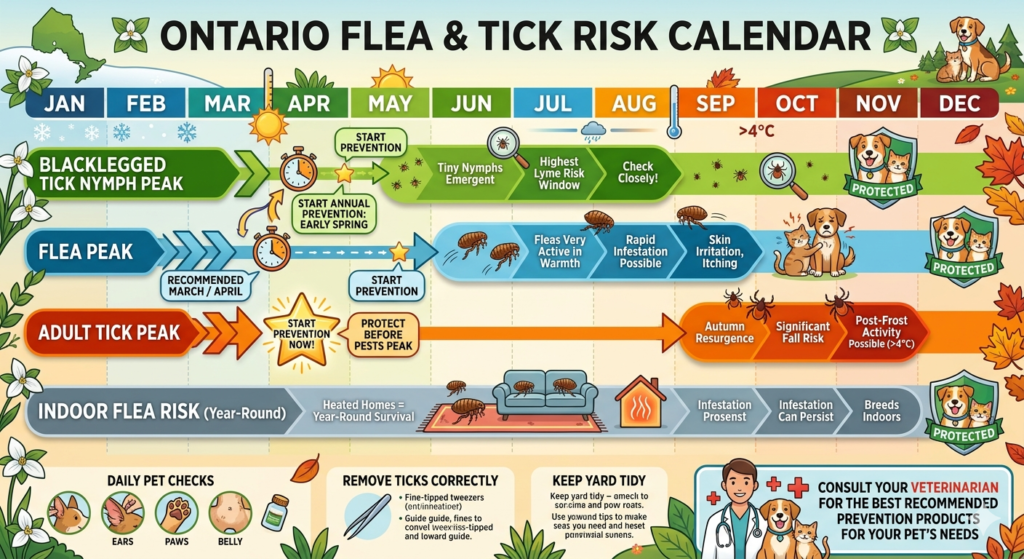
Ontario’s Flea and Tick Calendar: When the Risks Peak
Understanding when different parasites are most active helps you time prevention correctly. Ontario’s climate creates distinct seasonal risk windows for fleas and ticks, and they do not always overlap.
Spring (March through June)
Spring is the highest-risk window for tick-borne disease in Ontario. Blacklegged tick nymphs emerge during May and June, and this life stage is responsible for the majority of Lyme disease transmission. Nymphs are roughly the size of a poppy seed, making them extremely difficult to detect on your pet’s skin or coat. They feed for three to five days and can transmit Borrelia burgdorferi (the bacterium that causes Lyme disease) within 24 to 36 hours of attachment.
Flea activity also picks up in spring as temperatures rise and humidity increases. Fleas become reliably active once outdoor temperatures stay above 12 to 13 degrees Celsius, and they reproduce rapidly in warm, humid conditions.
This is the most critical season to have prevention already in place. Starting a preventive product after you find a tick on your pet means you have already missed the window.
Summer (July through August)
Flea pressure peaks during summer. A single female flea can lay up to 50 eggs per day, and those eggs drop into carpets, furniture, and bedding, hatching into larvae that can survive for months in indoor environments. Homes with central air conditioning provide a stable environment for flea development year-round, which is why summer infestations often persist well into fall and winter if not addressed at the source.
Tick risk does not disappear in summer, but the primary threat shifts. Larval ticks hatch during this period and begin feeding on small mammals. While larvae rarely carry Lyme disease pathogens at this stage, their presence signals that the local tick population is healthy and reproducing.
Fall (September through November)
Adult blacklegged ticks emerge in fall and remain active until sustained freezing temperatures arrive. Adults are larger than nymphs (roughly sesame-seed sized) and easier to spot, but they are still capable of transmitting Lyme disease and other pathogens including anaplasmosis, babesiosis, and Powassan virus.
This is the season when many pet owners mistakenly stop prevention, assuming the threat has passed. In reality, adult ticks actively seek hosts throughout October and into November in southern Ontario, and mild fall temperatures in recent years have extended this window further.
Winter (December through February)
Traditional thinking treats winter as a safe zone. It is not always. Blacklegged ticks do not die at the first frost. They enter a state of dormancy beneath leaf litter and snow cover, and they can become active again on any winter day that exceeds 4 degrees Celsius. Ontario has experienced increasingly frequent mid-winter warm spells, and veterinary clinics across the GTA report tick findings in December and January during mild stretches.
Fleas, meanwhile, are entirely unaffected by outdoor temperatures if they have already established themselves indoors. An untreated flea infestation in your home will continue cycling through egg, larva, pupa, and adult stages regardless of the season outside.
Flea and Tick Prevention Options: What Works and What Does Not
There is no shortage of parasite prevention products on the market, and the sheer number of choices creates confusion. Not every product works the same way, and some over-the-counter options carry significant safety risks, particularly for cats.
Oral Preventives
Oral flea and tick medications have become the preferred option for many veterinarians because they provide systemic protection, are not affected by bathing or swimming, and typically offer consistent month-long coverage. Most oral products work by circulating in the pet’s bloodstream, killing fleas and ticks when they bite.
Some oral products target fleas only, while others provide combined flea, tick, and sometimes heartworm and intestinal parasite protection. Your veterinarian can recommend the appropriate product based on your pet’s species, weight, age, health status, and lifestyle exposure risk.
Topical Preventives
Topical (spot-on) treatments are applied between the shoulder blades and distribute through the skin’s oil layer. They remain effective options when applied correctly and consistently. The most common issue with topical products is user error: applying too little, applying in a spot the pet can lick, bathing too soon after application, or allowing the product to contact another pet before it dries.
A critical safety warning for cat owners: Many topical flea and tick products formulated for dogs contain permethrin, a synthetic pyrethroid that is highly toxic to cats. Permethrin exposure in cats can cause tremors, seizures, and death. The Canadian Veterinary Medical Association and veterinary toxicology resources consistently flag this as one of the most common and preventable poisoning emergencies in feline medicine. Never apply a dog-labeled product to a cat, and keep treated dogs separated from cats until the topical product has fully dried.
Flea and Tick Collars
Modern prescription-grade flea and tick collars offer sustained release of active ingredients over several months and can be effective when used as directed. However, collars vary widely in quality. Over-the-counter collars sold at pet stores and grocery chains often provide minimal protection and create a false sense of security.
Natural and Alternative Products
Essential oil-based sprays, diatomaceous earth, garlic supplements, and similar “natural” flea and tick repellents are widely marketed to pet owners. The evidence supporting their effectiveness is limited. While some plant-based compounds do have mild repellent properties, they do not provide the consistent, reliable protection that veterinary-grade products deliver. In a region where ticks carry Lyme disease and other serious pathogens, relying solely on natural remedies introduces unnecessary risk.
Dogs vs. Cats: Why Prevention Protocols Differ
Dogs and cats face many of the same flea and tick threats, but their prevention protocols are not interchangeable.
| Factor | Dogs | Cats |
|---|---|---|
| Primary flea risk | Outdoor exposure, dog parks, wooded trails | Indoor-outdoor access, contact with infested environments |
| Primary tick risk | Direct outdoor exposure in tick habitat | Lower but real, especially for outdoor or semi-outdoor cats |
| Oral product options | Broad range of chewable preventives available | Fewer approved oral options; most feline prevention is topical |
| Permethrin safety | Safe when used as directed | Highly toxic; never use dog-labeled permethrin products on cats |
| Grooming factor | Less likely to remove ticks through self-grooming | May remove some ticks during grooming but cannot be relied upon as prevention |
| Indoor-only risk | Reduced but not eliminated (fleas enter on clothing, other pets) | Significant; indoor cats can develop flea infestations from household exposure |
Indoor cats are not immune. Fleas can hitch rides into your home on clothing, shoes, visiting pets, or even through screened windows and doors. A single flea introduction can trigger a full household infestation within weeks if no preventive is in place.
What Happens When Prevention Fails: Tick-Borne Disease in Ontario Pets
Flea and tick prevention is not just about comfort. In Ontario’s current parasite landscape, it is a genuine health intervention. The tick-borne diseases circulating in the province can cause serious illness in both dogs and humans.
Lyme disease is the most well-known tick-borne infection in Ontario. In dogs, Lyme disease can cause shifting-leg lameness, joint swelling, fever, lethargy, and in severe cases, a life-threatening kidney condition called Lyme nephritis. Many infected dogs show no symptoms for weeks or months after the initial tick bite, which makes routine screening through pet blood work particularly valuable. The SNAP 4Dx test, which can be run during a routine wellness visit, screens simultaneously for Lyme disease, anaplasmosis, ehrlichiosis, and heartworm.
Anaplasmosis attacks white blood cells and can cause fever, lethargy, loss of appetite, joint pain, and in some cases, bleeding disorders. It is transmitted by the same blacklegged tick that carries Lyme disease and has been confirmed in Ontario.
Babesiosis destroys red blood cells, leading to anemia, dark-coloured urine, weakness, and potentially organ failure. Cases have been increasing in Ontario as the blacklegged tick range expands. The Companion Animal Parasite Council (CAPC) tracks the spread of tick-borne pathogens across North America and has documented rising prevalence in the Great Lakes region.
Powassan virus is rare but extremely serious. Unlike Lyme disease, Powassan virus can be transmitted within minutes of tick attachment, meaning the standard 24-to-36-hour removal window that protects against Lyme disease does not apply. There is no specific treatment and outcomes can include permanent neurological damage.
Flea-borne disease is less commonly discussed but should not be dismissed. Heavy flea infestations can cause flea allergy dermatitis (one of the most common skin conditions in dogs and cats), tapeworm transmission (fleas serve as an intermediate host for Dipylidium caninum), and in kittens or small dogs, anemia from blood loss.
If your pet develops sudden lameness, unexplained fever, lethargy, or pale gums after a known or suspected tick or flea exposure, contact an emergency vet near me promptly. Early diagnosis and treatment significantly improve outcomes for tick-borne infections.
A Case That Reinforces the Basics
A three-year-old Labrador Retriever named Moose came into our clinic in late October with intermittent hind-leg lameness that his owner initially attributed to roughhousing at the dog park. Moose was otherwise eating well and seemed active, so the owner waited two weeks before scheduling a visit.
A veterinary lab test during his appointment revealed a positive result for Lyme disease on the SNAP 4Dx screen. Follow-up bloodwork confirmed active infection with elevated antibody levels. Moose had been on flea prevention through the summer but his owner had discontinued it in September, assuming tick season was over.
Moose responded well to a four-week course of doxycycline, and subsequent testing showed a declining antibody response. His case is textbook: an adult blacklegged tick attached during the fall peak season, during the exact window when his owner assumed protection was no longer needed.
The Ontario tick season does not end when summer does. Fall prevention is not optional.
Building a Year-Round Prevention Plan
Effective parasite prevention is not a single product decision. It is a layered approach that combines veterinary-grade preventives with environmental management and routine screening.
Step 1: Choose the right preventive products with your veterinarian. Your veterinarian will consider your pet’s species, breed, age, weight, health conditions, and outdoor exposure patterns before recommending a specific product. A preventive care for pets appointment is the right starting point for building a customized parasite prevention protocol.
Step 2: Maintain year-round coverage. In Ontario’s current climate, stopping prevention in the fall creates a gap that coincides directly with adult tick season. Many veterinarians now recommend 12-month flea and tick prevention for pets in the GTA, and the reasoning is supported by the provincial surveillance data. The American Veterinary Medical Association (AVMA) echoes this position for regions with expanding tick populations.
Step 3: Perform daily tick checks during peak seasons. Run your hands over your pet’s entire body after outdoor activity, paying close attention to the ears, around the eyes, under the collar, between the toes, around the tail base, and in the groin area. Use fine-tipped tweezers to remove any attached tick by grasping as close to the skin as possible and pulling straight out without twisting.
Step 4: Manage your home environment. Vacuum frequently, wash pet bedding in hot water weekly, and keep grass trimmed short. If your property borders wooded or naturalized areas, maintaining a clear buffer zone of gravel or wood chips between the lawn and tree line reduces tick migration into your yard.
Step 5: Screen annually for tick-borne disease. Even pets on consistent prevention should be tested annually. No preventive product is 100 percent effective, and early detection of a tick-borne infection allows treatment before clinical disease develops. Ask your veterinarian about including a 4Dx test as part of your pet’s annual wellness bloodwork.
When to Talk to Your Vet About Parasite Prevention
If any of the following apply to your pet, a conversation with your veterinarian about flea and tick prevention is overdue:
- Your pet has never been on a veterinary-recommended flea and tick preventive
- You stopped prevention during the fall or winter months
- You are using an over-the-counter product and are unsure of its effectiveness
- Your pet spends time outdoors in wooded areas, trails, ravines, or off-leash parks
- You have found a tick on your pet or on yourself after outdoor activity in the GTA
- Your cat lives with a dog who goes outdoors (cross-contamination risk)
- You have recently moved to Ontario from a region with different parasite pressures
You can book vet appointment online at South Etobicoke Animal Hospital or call us at +1 (416) 201-9123. Our veterinary team can assess your pet’s specific risk profile and recommend a prevention protocol tailored to their lifestyle and the current Ontario parasite landscape.
Frequently Asked Questions
-
Do indoor cats really need flea and tick prevention in Ontario?
Yes. Indoor cats are not protected from fleas simply because they stay inside. Fleas can enter your home on clothing, shoes, visiting pets, or even through open doors and windows. Once a single flea establishes itself indoors, the reproductive cycle begins immediately, and a full infestation can develop within weeks. Indoor cats are also at risk if they share a home with dogs who go outside. Consistent year-round flea prevention eliminates this vulnerability and avoids the difficulty of treating an established infestation after the fact.
-
When should I start flea and tick prevention for a puppy or kitten?
Most veterinary-grade flea and tick preventives are safe to begin once a puppy or kitten reaches eight weeks of age and meets the minimum weight requirement listed on the product label. Starting prevention early is important because young animals are especially vulnerable to flea anemia and tick-borne infections. Your veterinarian will confirm the right product and starting age for your specific pet during their first wellness visit, taking into account any breed sensitivities or health considerations.
-
Can I use a dog flea and tick product on my cat?
Never. Many canine flea and tick products contain permethrin, a compound that is safe for dogs but extremely toxic to cats. Permethrin poisoning in cats causes tremors, seizures, elevated body temperature, and can be fatal without emergency veterinary intervention. Always use species-specific products and keep recently treated dogs separated from cats in the household until the product has dried completely. If accidental exposure occurs, contact your veterinarian or an emergency clinic immediately.
-
How do I safely remove a tick from my pet?
Use fine-tipped tweezers to grasp the tick as close to your pet’s skin as possible. Pull upward with steady, even pressure without twisting or jerking. Twisting can cause the mouthparts to break off and remain embedded in the skin. After removal, clean the bite area with rubbing alcohol or soap and water. Save the tick in a sealed container or photograph it for identification. In Ontario, you can submit tick photos to eTick.ca, a free identification service operated in partnership with Public Health Ontario.
-
Is Lyme disease really a concern for pets in the Etobicoke and GTA area?
Absolutely. Public Health Ontario has classified the entire Greater Toronto Area as an established blacklegged tick risk zone. Ontario recorded over 3,100 confirmed human Lyme disease cases in 2025, and the case rate has increased twenty-five fold since 2010. Dogs are highly susceptible to Lyme infection, and untreated cases can cause lameness, kidney damage, and systemic illness. Annual screening with a 4Dx blood test and consistent year-round tick prevention are now standard recommendations for pets living in southern Ontario.
Protecting your pet from fleas and ticks in Ontario is no longer a seasonal afterthought. It is a year-round responsibility, and the right prevention plan starts with a conversation with your veterinarian.