
Hearing that your dog needs surgery is one of those moments that stops every pet owner in their tracks. It does not matter whether the procedure is a routine spay or something more urgent — the uncertainty of not knowing what happens behind the operating room doors is enough to keep anyone up at night. The truth is that modern veterinary surgical care has become remarkably safe and effective, but understanding the process from start to finish goes a long way toward easing that anxiety.
At South Etobicoke Animal Hospital, we believe that informed pet owners make the best decisions for their animals. This guide walks you through everything that happens before, during, and after your dog’s surgery at our Etobicoke vet hospital — so you know exactly what to expect and can focus on being there for your pet through recovery.
Why Dogs Need Surgery — Understanding the Common Reasons
Dogs end up on the surgical table for a wide range of reasons. Some procedures are planned well in advance, while others come as a surprise following an injury or sudden illness. Knowing the most frequent causes can help you understand why your veterinarian is recommending a surgical approach rather than medical management alone.
Routine and Elective Surgical Procedures
Spay and neuter operations remain the most commonly performed surgeries in veterinary medicine. Beyond preventing unwanted litters, these procedures carry real long-term health benefits. Spaying a female dog before her first heat cycle significantly reduces the risk of mammary tumours and eliminates the possibility of pyometra, a life-threatening uterine infection that sends thousands of dogs to emergency clinics across Canada every year. Neutering a male dog reduces the risk of certain prostate conditions and eliminates testicular cancer risk entirely.
Other routine procedures include lump and mass removals, wound repairs, dental cleanings under anaesthesia, and bladder stone removals. While these are considered elective or semi-elective, they are no less important. Delaying a lump removal, for instance, can allow a benign growth to become something more complex. For a detailed breakdown of the most frequent procedures and their recovery timelines, our guide on common veterinary surgical procedures covers each one thoroughly.
Non-Routine and Emergency Surgeries
Not all surgeries can be planned. Dogs are curious animals. They swallow things they should not — socks, corn cobs, children’s toys — and those foreign objects can create life-threatening intestinal blockages that require immediate surgical intervention. Hit-by-car injuries, bite wounds from other animals, bloat (gastric dilatation-volvulus), and ruptured abdominal masses are all scenarios where surgery becomes a matter of hours, not days.
In emergency situations, speed matters enormously. Having a pet clinic near me that offers on-site surgical capabilities, in-house diagnostics, and diagnostic imaging under one roof means the veterinary team can move from assessment to operating room without the delays of transferring your dog to a different facility. That continuity of care can genuinely be the difference between a good outcome and a devastating one.
Pre-Anesthetic Exams — The First Step Before Any Procedure
No responsible veterinary team puts a dog under anaesthesia without first confirming that the animal can handle it safely. The pre-anesthetic exam is a critical step that many pet owners do not realize happens behind the scenes, and it is one of the most important safeguards in the entire surgical process.
Physical Assessment and Health History
Before anything else, your dog receives a thorough physical examination. The veterinarian listens to the heart and lungs, checks for murmurs or arrhythmias, evaluates hydration status, assesses body condition, and looks for any abnormalities that could complicate anaesthesia. Your dog’s medical history is reviewed in detail, including any previous reactions to anaesthesia, current medications, and known health conditions.
This is where your input as the owner becomes valuable. Mention everything — even things that seem minor. A dog that has been coughing occasionally, drinking more water than usual, or acting lethargic might have an underlying issue that changes how the anaesthesia protocol is designed. If your dog has been receiving regular wellness exams at our clinic, we already have a detailed health baseline to work from, which makes pre-surgical assessment even more effective.
In-House Laboratory Testing and Pre-Surgical Bloodwork
Bloodwork is not optional fluff. It is a non-negotiable part of safe surgical practice. Pre-anesthetic blood panels check liver and kidney function, blood cell counts, clotting ability, blood glucose levels, and electrolyte balance. Each of these values directly affects how your dog will metabolize anaesthetic drugs and recover from the procedure.
A dog with elevated kidney values, for example, may require a modified anaesthesia protocol and additional intravenous fluid support. A dog with low red blood cell counts might need a transfusion before surgery can proceed safely. These are things that cannot be detected through physical examination alone — they require laboratory data.
Our clinic performs pre-surgical bloodwork on-site, which means results are available within minutes rather than days. For cases that require more specialized testing, we work with trusted partners through reference laboratory testing to ensure nothing is overlooked before your dog goes under anaesthesia.
Surgical Anesthesia and Monitoring — How We Keep Your Dog Safe
Anaesthesia is where most of the fear lies for pet owners. That fear is understandable, but it is worth knowing that veterinary anaesthesia protocols have evolved dramatically over the past decade. The American Veterinary Medical Association notes that anaesthesia-related deaths are rare, and that risks are more closely related to the pet’s general health than to the anaesthesia itself.
Tailored Anesthesia Protocols
There is no one-size-fits-all approach to anaesthesia in veterinary medicine. Every dog receives an individualized anaesthetic plan based on their breed, age, weight, health status, and the nature of the procedure being performed. Brachycephalic breeds like Bulldogs and Pugs, for example, require modified airway management due to their shortened nasal passages. Senior dogs with cardiac conditions need protocols that minimize cardiovascular strain.
The process typically begins with a pre-anesthetic sedative administered before the actual induction. This sedative calms your dog, reduces stress, and allows lower doses of the more potent anaesthetic agents to be used — which is safer overall. An intravenous catheter is placed to allow administration of fluids and emergency medications if needed. The dog is then induced with an injectable agent and maintained on gas anaesthesia delivered through an endotracheal tube that protects the airway and provides oxygen directly to the lungs.
Continuous Monitoring Throughout the Procedure
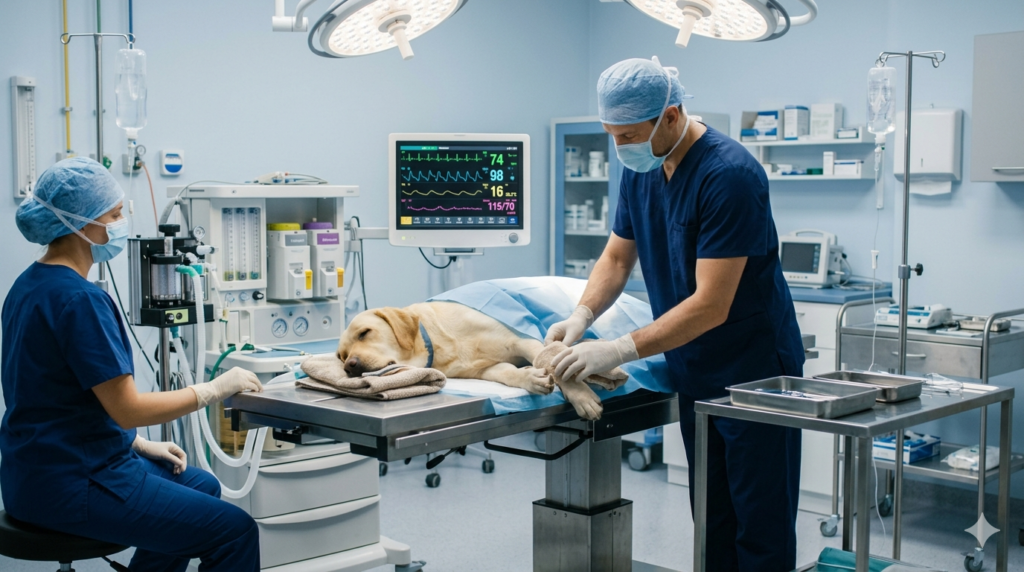
Once your dog is anaesthetized, a dedicated team member monitors vital signs continuously from the moment of induction through to full recovery. This is not a passive process. The American Animal Hospital Association’s anesthesia guidelines recommend monitoring heart rate, heart rhythm, blood pressure, oxygen saturation, carbon dioxide levels, respiratory rate, and body temperature throughout every anaesthetic event.
At our Etobicoke veterinary hospital, we use advanced multi-parameter monitors that display these values in real time. If blood pressure drops or the heart rate changes, the team responds immediately — adjusting fluid rates, modifying anaesthetic depth, or administering supportive medications. Body temperature is maintained with warming devices, because dogs under anaesthesia lose heat quickly and hypothermia can delay recovery.
This level of vigilance is what separates safe surgical practice from risky shortcuts. Equipment matters, certainly, but the presence of a trained, attentive team member dedicated solely to monitoring your dog’s anaesthetic status is the single most important safety factor in the operating room.
What Happens in the Operating Room
The actual surgical environment is designed to minimize risk and maximize precision. Veterinary operating rooms follow strict protocols that mirror human surgical standards in many respects.
Surgical Preparation and Sterile Environment
Before the surgeon picks up a scalpel, your dog is carefully positioned and the surgical site is prepared. The area is clipped, cleaned with antiseptic solutions, and draped with sterile materials to create a controlled field. The surgical team scrubs in, gowns, and gloves using aseptic technique to prevent any contamination.
Instruments are sterilized beforehand, and every item that enters the surgical field is accounted for. Checklists, similar to those used in human operating rooms, are increasingly standard in veterinary practice as well. These protocols may seem routine, but they are the backbone of infection prevention and surgical safety.
The Procedure Itself
The specifics of the surgery depend entirely on what is being treated. A spay involves making an abdominal incision, identifying and ligating the ovarian vessels, removing the uterus and ovaries, and closing the incision in multiple layers. A mass removal involves carefully dissecting the growth from surrounding tissue while preserving healthy structures. Foreign body removal from the intestine requires opening the affected section of bowel, extracting the object, and suturing the intestinal wall back together.
Regardless of the procedure, pain management is integrated throughout. Pre-emptive analgesics administered before surgery reduce the overall pain response, and local anaesthetic techniques such as incisional line blocks provide targeted relief at the surgical site. Pain management is not an afterthought — it is built into every stage of the anaesthetic and surgical plan.
Post-Operative Care — Recovery Starts Immediately
The period immediately following surgery is just as important as the procedure itself. How your dog wakes up, how pain is managed during recovery, and how you care for them at home all influence the final outcome.
In-Clinic Recovery and Observation
After the surgery is complete, the anaesthetic gas is discontinued and your dog begins to wake up. The endotracheal tube is removed once the swallowing reflex returns, and the dog is moved to a warm, quiet recovery area. A team member stays close, monitoring breathing, heart rate, and temperature until the patient is fully alert and responsive.
This transition period carries its own risks — nausea, disorientation, and occasionally emergence delirium can occur. Having trained staff observe your dog through the entire recovery phase ensures that any complications are caught and addressed immediately. Pain medication dosing continues as needed to keep your dog comfortable, and intravenous fluids may be maintained for several hours depending on the procedure.
At-Home Recovery Guidelines
When your dog is ready to go home, you will receive detailed post-operative instructions from the veterinary team. These typically include guidance on feeding, activity restriction, medication administration, and incision monitoring.
General at-home recovery guidelines for most surgical patients include withholding food for the first few hours after arriving home to prevent nausea, offering small amounts of water initially and watching for vomiting, feeding a bland, small meal once your dog is alert and showing interest in food, restricting activity and preventing jumping, running, or rough play for the recommended recovery period, checking the incision daily for redness, swelling, discharge, or opening, and administering all prescribed pain medications and antibiotics on schedule without skipping doses.
An Elizabethan collar or surgical recovery suit is usually sent home to prevent your dog from licking or chewing at the incision. Resist the temptation to remove it early — incision complications caused by licking are one of the most common and avoidable post-surgical issues veterinarians see.
How to Prepare Your Dog for Surgery Day
Preparation on your end plays a bigger role than most owners realize. Your veterinarian will likely ask you to withhold food for eight to twelve hours before the procedure. This reduces the risk of aspiration during anaesthesia. Water is generally permitted until a few hours before admission, but follow your specific clinic’s instructions.
Bring any medications your dog is currently taking to the appointment. Make sure you have arranged a quiet recovery space at home before you leave — a clean, padded area away from stairs, other pets, and small children. Ask any questions you have during the admission process. No question is too minor when it comes to your dog’s safety.
When Surgery Cannot Wait — Emergency Situations
Emergencies do not respect schedules. A dog that swallows a foreign object on a Saturday evening or develops bloat during the middle of the night needs immediate surgical evaluation. Searching for an emergency vet near me who can provide rapid assessment, on-site imaging, and surgical intervention without transfer delays can save your dog’s life.
At our clinic, the veterinary surgical care team has access to everything needed to handle emergency cases — from digital X-rays and ultrasound to a fully equipped operating suite and in-house recovery monitoring. When time is the critical variable, having all of those capabilities in one location is an advantage that matters.
The Canadian Veterinary Medical Association recognizes surgical care and anaesthesia monitoring as core competencies within veterinary practice. Clinics that invest in modern surgical equipment, trained support staff, and structured anaesthesia protocols are better positioned to deliver safe outcomes across both routine and emergency procedures.
Frequently Asked Questions About Dog Surgery in Etobicoke
-
How safe is anaesthesia for dogs?
Modern veterinary anaesthesia is very safe for the vast majority of healthy dogs. Pre-anesthetic bloodwork, individualized drug protocols, and continuous monitoring of heart rate, blood pressure, and oxygen levels throughout surgery all reduce risk significantly. Anaesthesia-related complications are rare in properly screened patients. Your veterinarian will discuss any breed-specific or age-related risk factors before the procedure and adjust the anaesthetic plan accordingly.
-
How long does a typical dog surgery take?
The duration depends entirely on the procedure. A routine spay or neuter usually takes between thirty and sixty minutes of actual surgical time. More complex operations like foreign body removal, mass excision, or orthopaedic repair can take one to three hours or longer. Your veterinarian will give you an estimated timeline during the admission appointment so you know roughly when to expect an update call from the surgical team.
-
What should I watch for during my dog’s recovery at home?
Monitor your dog’s incision daily for signs of infection such as increasing redness, swelling, heat, or discharge. Watch for persistent vomiting, refusal to eat beyond twenty-four hours, extreme lethargy, laboured breathing, or any sudden change in behaviour. If you notice any of these signs, contact your veterinary team immediately. Most dogs recover smoothly, but early intervention on any complication makes a significant difference in the outcome.
-
Can my dog eat and drink after surgery?
Water can usually be offered in small amounts once your dog is alert and standing steadily. A small, bland meal can be provided two to three hours after arriving home, provided there is no vomiting. Avoid large meals on the first evening after surgery. Resume your dog’s normal feeding schedule the following day unless your veterinarian has given different instructions based on the type of procedure performed.
-
Does my dog need pre-surgical bloodwork even if they seem healthy?
Yes. Pre-surgical bloodwork is a critical safety measure regardless of your dog’s outward appearance. Dogs can have underlying liver or kidney conditions, clotting abnormalities, or electrolyte imbalances that are completely invisible during a physical exam. These conditions directly affect how anaesthetic drugs are metabolized and how safely your dog recovers. Skipping bloodwork to save time or cost is a risk that no reputable veterinary hospital in Etobicoke would recommend taking.
-
How soon after surgery can my dog return to normal activity?
Most dogs require ten to fourteen days of restricted activity following surgery. This means no running, jumping, swimming, or rough play. Leash walks for bathroom breaks only during the initial recovery period. Your veterinarian will advise on when your dog can gradually resume normal activity based on how the incision is healing and the complexity of the procedure. Orthopaedic surgeries and abdominal procedures typically require longer restriction periods than minor skin surgeries.
-
What makes South Etobicoke Animal Hospital a good choice for dog surgery near me?
Our clinic combines on-site surgical capabilities with in-house laboratory testing, advanced diagnostic imaging, and dedicated anaesthesia monitoring in a single location at 741 The Queensway, Etobicoke. This means every stage of your dog’s surgical journey — from pre-anesthetic bloodwork through post-operative recovery — happens under one roof with the same veterinary team. We serve pet families across Etobicoke, Mimico, Long Branch, New Toronto, and the Greater Toronto Area with extended availability for both scheduled procedures and urgent surgical cases.