
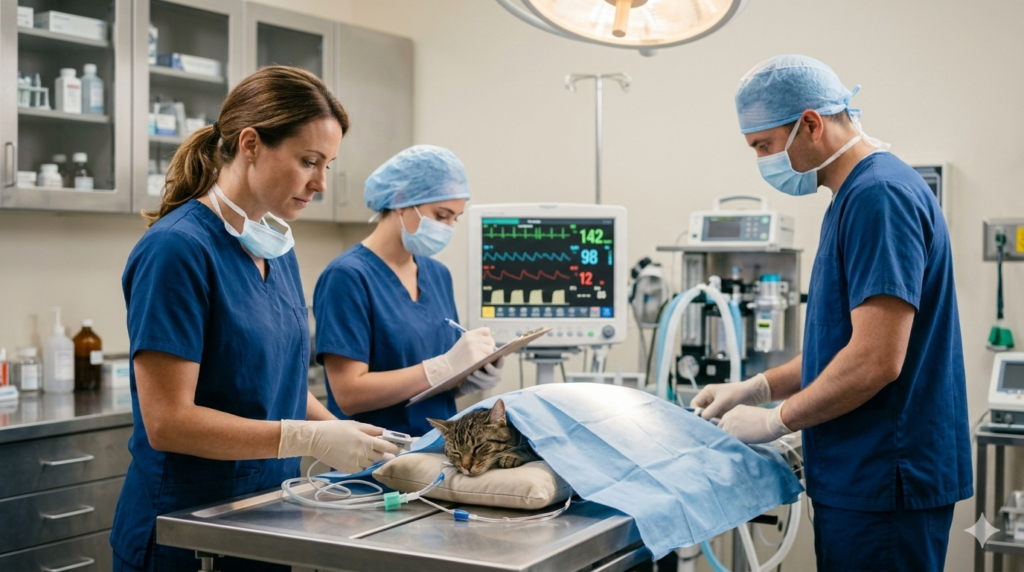
There is a particular kind of anxiety that takes hold when a veterinarian tells you that your pet needs surgery. Your mind races through worst-case scenarios, your stomach drops, and suddenly the animal sleeping peacefully on the exam table feels incredibly fragile. It is one of the most stressful experiences a pet owner can go through, and the fear is completely understandable.
But here is what that fear usually comes down to: uncertainty. Not knowing what the procedure involves, not understanding why certain tests are needed beforehand, and not being able to picture what the recovery period will actually look like. When those unknowns get replaced with real information, most of that fear starts to loosen its grip.
This guide was written to walk you through the full surgical journey at South Etobicoke Animal Hospital, from the first consultation all the way through to your pet’s post-operative follow-up. We are going to cover the types of veterinary surgical services we perform, what pre-surgical diagnostics look like, how we approach pain management and anesthesia monitoring, and what you should realistically expect during recovery. No vague reassurances. Just the details that actually help.
Why Understanding the Surgical Process Matters More Than You Think
Veterinary teams across Ontario perform thousands of surgical procedures every year, and the vast majority go smoothly. But the families who have the easiest time navigating the experience are almost always the ones who understood what was happening at each stage. They asked questions. They knew what pre-operative fasting meant and why it mattered. They had a recovery plan ready at home before surgery day arrived.
When you are informed about the process, you make better decisions. You catch post-operative warning signs earlier. You follow aftercare instructions more consistently. And your pet, in turn, heals faster because their environment supports it. Pet surgery in Etobicoke or anywhere else is not just about what happens on the operating table. It is a team effort between the surgical team and the family at home.
Pre-Surgical Diagnostics: The Work That Happens Before the Scalpel
Every safe surgery begins long before the operating room lights come on. Pre-surgical diagnostics are the foundation of responsible animal surgical care, and at South Etobicoke Animal Hospital, we take them seriously regardless of whether the procedure is a routine spay or a complex emergency intervention.
The process typically starts with a comprehensive physical examination. Your veterinarian will assess your pet’s heart and lung sounds, check lymph nodes, evaluate body condition, and look for any signs of illness that might not be immediately obvious. This hands-on evaluation often reveals concerns that change the surgical plan, sometimes in small ways, sometimes significantly.
Next comes bloodwork. A standard pre-surgical blood panel includes a complete blood count (CBC) and a chemistry profile. The CBC reveals whether your pet has adequate red blood cells to carry oxygen during anesthesia, whether white blood cell counts suggest hidden infection, and whether platelet levels support normal clotting. The chemistry panel evaluates liver and kidney function, two organs that play a central role in processing anesthetic drugs. If either organ is compromised, anesthesia protocols need to be adjusted or, in some cases, the surgery needs to be postponed until the underlying issue is addressed.
Our in-house diagnostics laboratory delivers results in minutes rather than days. That speed matters because it means we can evaluate, plan, and proceed on the same day when time-sensitive cases require it. For more complex situations, we also partner with trusted reference laboratories including IDEXX and Antech for advanced testing like hormone panels, pathology analysis, and specialized cultures.
Depending on the type of surgery, medical imaging may also be required. Digital radiographs help us evaluate bone structure, chest health, and organ positioning. Ultrasound gives us a real-time view of soft tissue structures, fluid accumulation, and abdominal organ integrity. Together, these tools allow the surgical team to plan the approach before making a single incision, reducing surprises in the operating room and shortening time under anesthesia.
Pain Management and Anesthesia Monitoring: The Invisible Half of Every Surgery
Ask any experienced veterinary surgeon what matters most during a procedure, and the answer will almost certainly involve anesthesia safety. Pain management and anesthesia monitoring are not side notes to the surgical process. They are, in many ways, the most critical components of it.
Every patient at South Etobicoke Animal Hospital receives an individualized anesthesia protocol. There is no one-size-fits-all formula. A two-kilogram cat with hyperthyroidism requires a fundamentally different drug combination than a healthy 30-kilogram Golden Retriever coming in for a neuter. Age, breed, body weight, organ function, and the specific procedure all factor into the anesthesia plan.
Before induction, most patients receive a pre-anesthetic sedation and pain medication. This serves two purposes: it calms the animal and reduces the amount of general anesthetic needed, which in turn lowers the overall risk. Pain management is not something we add after the fact. It begins before surgery, continues throughout the procedure, and extends well into the recovery period. This approach, known as multimodal analgesia, uses different types of medications that work on different pain pathways simultaneously, providing more effective relief with fewer side effects than relying on a single drug.
During the procedure itself, a dedicated team member monitors vital signs continuously. Heart rate, blood pressure, respiratory rate, oxygen saturation, end-tidal carbon dioxide, and body temperature are all tracked in real time. Any deviation from the expected range triggers an immediate response, whether that means adjusting the anesthetic depth, administering fluids, or providing supplemental warming. This level of vigilance is what separates a modern vet surgery facility from an outdated one.
We also maintain active warming throughout every procedure because hypothermia during anesthesia is a genuine and underappreciated risk. Small patients, thin-coated breeds, and geriatric animals are particularly vulnerable. Heated surgical tables, warm IV fluids, and forced-air warming blankets are standard elements of our surgical protocol.
Soft Tissue Surgery: The Broadest Category in Veterinary Medicine
Soft tissue surgery encompasses any procedure that does not involve bones or joints. It is by far the most common category of pet surgery performed in general veterinary practice, and it covers an enormous range of conditions and anatomical areas.
Abdominal surgeries form a significant portion of soft tissue work. Foreign body removal is a classic example. Dogs and cats have an astonishing capacity for swallowing things that were never meant to be eaten. Socks, hair elastics, corn cobs, pieces of toys, and even fishhooks are all items that veterinary surgeons encounter regularly. When an object becomes lodged in the stomach or intestines and cannot pass on its own, an exploratory laparotomy, the surgical opening of the abdomen, becomes necessary to locate and remove the obstruction before it causes a perforation or tissue death.
Bladder stone removal (cystotomy) is another frequently performed abdominal surgery. Certain breeds, including Dalmatians, Miniature Schnauzers, and Shih Tzus, are genetically predisposed to forming urinary stones that can cause painful urination, recurrent infections, and in severe cases, complete urinary blockage. Surgery to remove the stones and flush the bladder, combined with dietary management afterward, typically resolves the problem.
Mass and tumor excisions also fall under soft tissue surgery. Skin masses, mammary tumors, splenic masses, and oral growths all require surgical removal with appropriate margins. The tissue is then submitted for histopathological analysis to determine whether the growth is benign or malignant and whether further treatment is warranted. Early removal, guided by thorough diagnostic imaging, consistently produces better outcomes than a wait-and-see approach.
Spay and Neuter Procedures: Still the Gold Standard of Preventive Surgery
Spay and neuter procedures deserve their own discussion because they remain the most frequently performed veterinary surgical services in the world, and because there is more nuance to them than many pet owners realize.
Spaying a female dog or cat is a major abdominal surgery. It involves the complete removal of the ovaries and uterus through a midline incision, performed under full general anesthesia with continuous monitoring. Despite being classified as “routine,” it is not a minor procedure. It requires precise surgical technique, careful hemostasis to control bleeding from the ovarian pedicles, and proper closure of multiple tissue layers. When performed correctly, the health benefits are substantial. The risk of mammary cancer drops dramatically when spaying occurs before the first or second heat cycle. Pyometra, a potentially fatal uterine infection that affects roughly 25 percent of intact female dogs by age ten, is eliminated entirely.
Neutering a male dog or cat is comparatively less invasive but still demands proper surgical and anesthetic protocols. The procedure removes both testicles through a small incision, typically in front of the scrotum in dogs and on the scrotum itself in cats. Beyond population control, neutering reduces roaming behavior, inter-male aggression, and the incidence of testicular cancer and prostatic disease.
Timing is a conversation worth having with your veterinarian. The traditional recommendation of six months still holds for many breeds, but large and giant-breed dogs may benefit from a slightly delayed timeline to allow for musculoskeletal development. Our team discusses individual timing recommendations during wellness visits, taking into account breed, lifestyle, and the latest veterinary research.
Orthopedic Surgery: When Bones, Joints, and Ligaments Are Involved
Orthopedic surgery addresses conditions affecting the skeletal system, including fracture repair, ligament stabilization, and joint correction. These are often the most technically demanding procedures in veterinary medicine, and they carry some of the longest recovery timelines.
Cranial cruciate ligament (CCL) tears are among the most common orthopedic injuries in dogs, particularly in medium to large breeds. The cruciate ligament stabilizes the knee joint, and when it ruptures, either from a sudden traumatic event or from gradual degeneration, the result is immediate lameness, joint instability, and progressive arthritis. Surgical stabilization is the standard of care for most dogs over about 15 kilograms, because conservative management in that weight range rarely produces a satisfactory long-term outcome.
Fracture repair following trauma is another core component of orthopedic work. Depending on the fracture type, treatment may involve external coaptation with casts or splints for simple, stable fractures in young animals, or internal fixation using pins, plates, and screws for more complex breaks. Each approach has its place, and the decision depends on the fracture location, the patient’s age and size, and the degree of soft tissue damage surrounding the break.
Luxating patella correction, which involves realigning a kneecap that repeatedly slips out of its groove, is particularly common in small-breed dogs like Pomeranians, Chihuahuas, and Yorkshire Terriers. Grades one and two can sometimes be managed conservatively with weight control and activity modification, but grades three and four almost always require surgical intervention to prevent ongoing cartilage erosion, chronic pain, and secondary ligament damage.
At South Etobicoke Animal Hospital, we evaluate each orthopedic case individually using physical examination and diagnostic imaging. When a case falls outside the scope of general practice, we provide honest referral recommendations to board-certified veterinary surgeons who specialize in advanced orthopedic reconstruction.
Emergency Surgical Care: When Waiting Is Not an Option
Emergency surgical care represents the highest-stakes category of veterinary surgery. These are cases where delay can mean the difference between survival and loss, and where the speed of response is as important as the skill of the surgeon.
Gastric dilatation-volvulus, commonly referred to as bloat, is one of the most urgent surgical emergencies in canine medicine. The stomach fills with gas, expands, and then rotates on its axis, cutting off blood supply to the stomach wall and spleen simultaneously. Without surgical correction within hours, the condition is fatal. Large, deep-chested breeds, Great Danes, German Shepherds, Weimaraners, and Standard Poodles, carry the highest risk, but it can occur in any dog. Emergency decompression followed by a gastropexy, which surgically tacks the stomach to the abdominal wall to prevent recurrence, is the standard treatment.
Internal bleeding from splenic tumors is another surgical emergency that often presents with sudden collapse, pale gums, and rapid breathing. A ruptured hemangiosarcoma or hematoma can cause life-threatening blood loss into the abdomen within minutes. Emergency splenectomy, while a major procedure, is frequently lifesaving when performed quickly.
If you ever find yourself searching for an emergency vet hospital near me during a crisis, our emergency and urgent care team at South Etobicoke Animal Hospital is equipped for rapid triage, stabilization, and surgical intervention during all operating hours. We are open Monday, Tuesday, Thursday, and Friday from 12 PM to 10 PM, and Saturday and Sunday from 12 PM to 12 AM. Our direct line is +1 (416) 201-9123.
A Surgical Journey: What One Family’s Experience Looked Like
The following scenario is based on a composite of common cases seen in veterinary practice and is shared for educational purposes.
A five-year-old French Bulldog named Beau had been vomiting intermittently for two days. His owner initially assumed it was a minor stomach upset, something every dog goes through now and then. But when Beau stopped eating entirely on the third day and became lethargic, she brought him in for evaluation.
The physical exam revealed mild abdominal tenderness. Bloodwork showed mildly elevated white blood cells, suggesting an inflammatory process. An abdominal radiograph revealed a suspicious density in the small intestine. A follow-up ultrasound confirmed the finding: a foreign body consistent with a small rubber ball lodged in the jejunum.
The surgical team moved quickly. Pre-anesthetic medications were administered to manage pain and reduce anxiety. An individualized anesthesia plan accounted for Beau’s brachycephalic anatomy, a critical consideration for flat-faced breeds who carry higher anesthetic risk due to their narrow airways. The foreign body was removed through a single enterotomy incision, and the intestine was inspected for any signs of tissue compromise before the abdomen was closed in layers.
Beau spent the rest of the evening recovering under observation with IV fluids, anti-nausea medication, and continued pain management. By the following morning, he was eating a small meal. His owner took him home with a clear set of aftercare instructions, and at his 10-day follow-up, the incision had healed completely. The rubber ball, it turned out, had been a toy that rolled under the couch weeks earlier.
Stories like this are not unusual. They are, in fact, a regular part of life at a veterinary hospital. What makes the difference is the speed of diagnosis, the quality of surgical care, and the thoroughness of post-operative monitoring. You can read more about real recovery journeys in our patient stories from our Etobicoke vet hospital.
What to Expect on Surgery Day: A Walkthrough for Pet Owners
Surgery day tends to feel longer than it actually is, mostly because the waiting is hard. Knowing the timeline helps.
You will be asked to withhold food for 8 to 12 hours before the scheduled procedure. Water is usually permitted until a few hours before drop-off. When you arrive, a technician will review your pet’s medical history, confirm the procedure, and answer any last-minute questions. This is also when we verify that pre-surgical bloodwork has been completed and reviewed.
Your pet will receive a pre-anesthetic sedation and pain medication, which takes effect over 15 to 30 minutes. Once they are calm and comfortable, general anesthesia is induced, an endotracheal tube is placed to protect the airway, and monitoring equipment is attached. The surgical site is clipped, cleaned, and prepped under sterile conditions.
During the surgery, your pet is never left unmonitored. A dedicated team member tracks vital signs continuously while the surgeon operates. Once the procedure is complete, anesthesia is gradually reversed, and your pet is moved to a warm, quiet recovery area where a technician stays close until they are fully alert and stable.
Most owners receive a phone call within an hour or two of the procedure to let them know how things went. Discharge typically happens later the same day for straightforward procedures, though some surgeries require overnight monitoring. At discharge, you receive written aftercare instructions covering medication schedules, activity restrictions, incision care, and warning signs that should prompt a follow-up call.
Recovery at Home: The Owner’s Role in a Successful Outcome
The surgical team controls what happens in the operating room, but recovery is a shared responsibility. What you do at home during the first two weeks after surgery has a direct impact on how well your pet heals.
Activity restriction is the single most important aftercare instruction, and it is also the hardest one to follow. Dogs, especially young ones, often feel much better within 48 hours of surgery and want to run, jump, and play as if nothing happened. That impulse needs to be contained. Internal sutures take 10 to 14 days to develop adequate strength, and premature activity can cause dehiscence (wound breakdown), seroma formation, or damage to surgical repairs. Crate rest, short leash walks for bathroom breaks, and mental enrichment like puzzle feeders are the standard approach.
The Elizabethan collar is non-negotiable for incision protection. Pets will lick. They will chew. And when they do, they introduce bacteria directly into the surgical site, creating a risk of infection that is entirely preventable. Modern alternatives like inflatable recovery collars and surgical suits exist, but the classic cone remains the most reliable barrier for the majority of patients.
Monitor the incision site daily. A small amount of swelling and bruising around the incision is normal in the first few days. What is not normal is increasing redness, heat, discharge with an odor, or gaps in the skin closure. If you see any of those signs, call your veterinarian promptly.
What Sets a Trusted Surgical Team Apart
Not every veterinary clinic offers the same level of surgical capability, and that is not a criticism; it is simply a reality. When you are evaluating where to take your pet for surgery, there are a few things worth considering.
On-site diagnostics matter. A clinic that can run bloodwork, take radiographs, and perform ultrasound in-house is able to move faster and with more precision than one that needs to send samples out and wait for results. South Etobicoke Animal Hospital maintains a full in-house diagnostic laboratory and digital imaging suite for exactly this reason.
Anesthesia monitoring standards matter. Continuous monitoring of multiple vital parameters, heart rate, blood pressure, oxygen, CO2, and temperature, should be the baseline expectation for any surgical procedure. If a clinic is not doing this, it is cutting corners in the area where they matter most.
Extended operating hours matter. Surgical complications can arise after the procedure, and knowing that your pet care team is accessible during evenings and weekends provides a genuine safety net. Our hospital is open until 10 PM on weekdays and midnight on weekends (closed Wednesdays), which means we are here during the hours when concerns most often come up.
If you want to learn more about the team behind our surgical program, our Meet Our Etobicoke Veterinarians page introduces the people who will be caring for your pet from consultation through recovery.
Frequently Asked Questions About Pet Surgery in Etobicoke
-
What types of veterinary surgical services does South Etobicoke Animal Hospital offer?
We perform a wide range of procedures including spay and neuter surgeries, soft tissue surgery such as mass removal and foreign body extraction, wound repair, emergency surgical care, and orthopedic evaluations. Each surgery is supported by in-house diagnostics and continuous anesthesia monitoring.
-
How do I know if my pet needs pre-surgical diagnostics?
Pre-surgical bloodwork and imaging are recommended for virtually every surgical patient, regardless of age. These tests evaluate organ function, blood clotting ability, and overall health status, allowing the surgical team to customize the anesthesia protocol and identify any hidden risks before the procedure begins.
-
Is anesthesia safe for older pets or those with health conditions?
Modern veterinary anesthesia is remarkably safe when protocols are tailored to the individual patient. Senior pets and those with chronic conditions receive adjusted drug combinations, additional monitoring, and supportive care such as IV fluids and active warming to minimize risk throughout the procedure.
-
What does pain management look like before, during, and after surgery?
We use a multimodal approach that starts with pre-anesthetic pain medication before surgery begins. Pain relief continues through injectable medications during the procedure and transitions to oral medications for home recovery. This layered strategy targets different pain pathways for more effective relief with fewer side effects.
-
How long does recovery from pet surgery usually take?
Recovery depends on the procedure. Simple surgeries like neuters may require 7 to 10 days of activity restriction, while abdominal or orthopedic surgeries can require 4 to 12 weeks of careful rehabilitation. Your veterinary team will provide a tailored recovery plan at discharge.
-
Do you offer emergency surgical care during evenings and weekends?
Yes. Our hospital is open Monday, Tuesday, Thursday, and Friday from 12 PM to 10 PM, and Saturday and Sunday from 12 PM to 12 AM. We are closed on Wednesdays. Emergency cases are seen without a prior appointment during all operating hours.
-
What should I do if I notice something concerning at my pet’s incision site?
Contact your veterinarian promptly if you observe increasing redness, swelling, heat, discharge with an odor, or any gaps in the skin closure. Mild bruising and slight swelling in the first 48 hours are considered normal, but worsening signs should always be evaluated.
-
Can I visit or stay with my pet during surgery?
For safety and sterility reasons, owners are not present in the surgical suite during procedures. However, our team calls you as soon as the surgery is complete to update you on how everything went, and most patients are discharged the same day.
-
How do I schedule a surgical consultation at your hospital?
You can call us directly at +1 (416) 201-9123 or email petcare@southetobicokeanimalhospital.ca to book a consultation. Our hospital is located at 741 The Queensway, Etobicoke, ON M8Z 1M8, Canada.
-
Where can I learn more about your diagnostic capabilities?
Our blog covers this in depth. You can start with our article on the top 5 questions pet owners ask about veterinary diagnostics in Etobicoke for a thorough overview of the testing and imaging tools we use to support every surgical case.
Your Pet Deserves a Surgical Team That Communicates Every Step
Surgery is never a decision to take lightly. But when the need arises, whether it is a planned spay, an overdue lump removal, or a late-night emergency that could not have been predicted, what matters most is the team standing beside your pet on the table.
At South Etobicoke Animal Hospital, we believe that transparent communication, rigorous safety protocols, and genuine compassion for both the pet and the person who loves them are the three pillars of good surgical care. We do not rush through conversations, we do not skip diagnostic steps, and we do not treat any procedure as routine enough to cut corners on monitoring.
If your pet is facing a surgical procedure, or if you have been putting off an evaluation because the idea of surgery feels overwhelming, we are here to talk it through. Call us at +1 (416) 201-9123, email petcare@southetobicokeanimalhospital.ca, or visit us at 741 The Queensway, Etobicoke. We are open late on weekdays and weekends for exactly the families who need us most.