
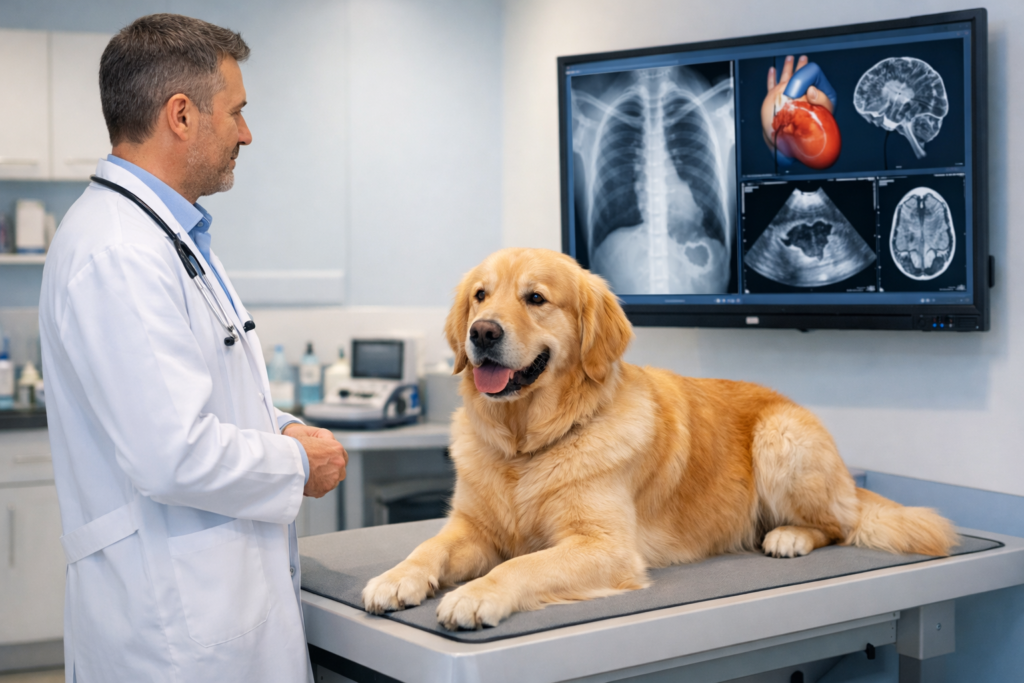
When something seems off with your pet — a change in appetite, unusual lethargy, or a sudden symptom that wasn’t there yesterday — the first instinct is to get them checked. But for many pet owners in Etobicoke, the diagnostic process itself raises as many questions as it answers. What tests will the vet run? How long will results take? What does “imaging” actually involve for a dog or cat?
At South Etobicoke Animal Hospital, these are conversations we have with pet families every day. Getting clear, honest answers to your questions is part of how we build trust, and trust is the foundation of good veterinary care. Below, we’ve answered the five questions we hear most often about veterinary diagnostics in Etobicoke — so you feel informed and confident walking through our doors.
What Is Veterinary Diagnostics, and Why Does My Pet Need It?
Most people understand that a vet “runs tests,” but the word diagnostics can feel vague or clinical. Simply put, veterinary diagnostics refers to the tools, tests, and procedures a veterinarian uses to figure out what is happening inside your pet’s body — things that can’t be seen with the naked eye during a standard physical exam.
Think of it this way: when your dog is limping or your cat stops eating, a physical exam gives your vet important clues, but diagnostics give them the full picture. Blood panels reveal how organs are functioning. Urinalysis can detect infections or kidney issues before they become severe. Imaging shows whether that abdominal swelling is gas, fluid, or something that needs immediate intervention.
For pet owners searching for a dog veterinarian near me who does more than a surface-level check, diagnostics are how thorough veterinary medicine works. They allow your vet to confirm a diagnosis rather than guessing — and more importantly, they allow treatment to begin from a place of certainty rather than assumption.
At South Etobicoke Animal Hospital, diagnostics are not reserved for sick pets alone. We incorporate diagnostic screening into wellness visits to catch problems early, often before symptoms appear at all.
What’s the Difference Between In-House Diagnostics and a Reference Laboratory?
This is one of the most common points of confusion for pet owners, and it’s a genuinely important distinction.
In-house diagnostics refer to tests performed right inside the clinic — on equipment your vet has on-site. If your pet’s blood is drawn at South Etobicoke Animal Hospital and the results are ready before you leave, that’s in-house diagnostics at work. Our in-house pet laboratory is capable of running rapid blood panels, urinalysis, fecal screening, cytology, and microscopy. For many conditions, speed is the difference between catching a problem early and managing a crisis. That’s the primary advantage of in-house testing — results in minutes, not days.
Reference laboratory testing, on the other hand, involves sending samples to specialized external labs that have equipment and expertise beyond what any single clinic can house. These animal health laboratories — in our case, trusted partners like IDEXX, Antech, and VARL — handle complex cases: hormone panels, thyroid testing, detailed pathology, culture analysis, and more. When a diagnosis requires a deeper level of analysis, these clinical reference laboratory partners provide the precision and comprehensive reporting that supports accurate treatment decisions.
The practical takeaway for you as a pet owner: most routine visits and urgent situations are handled with in-house results. When a condition is complex, unusual, or requires specialist-level confirmation, we send samples externally — often the same day — to ensure your pet’s diagnosis is built on the strongest possible evidence.
What Does Veterinary Imaging Involve, and Is It Safe?
Many pet owners hear “imaging” and immediately wonder whether it involves radiation, sedation, or lengthy procedures. The reassuring answer is that modern veterinary imaging is designed to be quick, safe, and as stress-free as possible for your pet.
At South Etobicoke Animal Hospital, our in-house medical imaging services include two primary modalities:
Digital X-rays (Radiographs): These are used to assess bone structures, joint health, chest conditions, and abdominal abnormalities. Digital radiographs are faster and expose pets to significantly less radiation than older film-based systems. Most X-rays are completed within minutes and do not require sedation unless a pet is in significant pain or unable to stay still.
Ultrasound: Our ultrasound clinic capability allows our veterinarians to visualize soft tissue structures in real time — the heart, liver, spleen, kidneys, bladder, and reproductive organs, among others. Ultrasound uses sound waves, not radiation, making it completely safe even for pregnant animals. It’s particularly valuable for evaluating abdominal concerns, detecting masses, and monitoring organ function.
Together, these tools make up the foundation of diagnostic imaging at our hospital. Imaging and lab result reviews happen in-house during your visit, which means your vet can discuss findings with you directly rather than asking you to wait for a callback.
For pets with complex presentations, our vets review imaging alongside laboratory findings to arrive at a complete clinical picture — that combination is often what separates a confident diagnosis from an uncertain one.
What Should I Expect During an Emergency Diagnostic Evaluation?
When a pet is in distress — struggling to breathe, unresponsive, vomiting repeatedly, or showing signs of severe pain — every minute matters. Emergency diagnostic evaluations are structured differently from routine appointments, and knowing what to expect can help you feel less overwhelmed when you arrive.
At South Etobicoke Animal Hospital’s emergency urgent care service, the process begins immediately upon arrival. Your pet is triaged and stabilized before anything else happens. Our emergency team assesses the situation rapidly, then initiates diagnostic testing as needed based on what they observe.
Emergency diagnostic evaluations typically involve a fast sequence of steps: a focused physical exam, followed by targeted in-house diagnostics. Depending on the situation, this might mean bloodwork to evaluate organ function, a urinalysis to screen for toxins or infection, or immediate digital X-rays to rule out obstructions, fractures, or internal bleeding. For suspected abdominal emergencies, ultrasound is often brought in as well.
The key difference in an emergency context is prioritization. We don’t run tests for completeness — we run the tests most likely to answer the most urgent clinical question. Treatment often begins in parallel with diagnostics rather than waiting for every result.
Families across the Queensway area and beyond rely on South Etobicoke Animal Hospital for emergency care because we’re equipped to handle these situations without sending you elsewhere. As an emergency vet clinic in Etobicoke, we’re open until 10 PM Monday, Tuesday, Thursday, and Friday — and until midnight on Saturday and Sunday. We’re closed Wednesdays.
If your pet is showing signs of a medical emergency, call us at +1 (416) 201-9123. Our team will advise you on what to do on the way in.
What Is Preventive Screening, and How Often Should My Pet Be Tested?
This is the question that often gets skipped — because when a pet looks healthy, testing can feel unnecessary. But preventive screening is one of the highest-value things you can do for a pet’s long-term health, and the data consistently supports it.
Preventive screening refers to diagnostic testing performed on apparently healthy pets to detect early-stage disease before clinical signs develop. Many of the most serious conditions in dogs and cats — kidney disease, diabetes, hypothyroidism, liver dysfunction, heartworm infection — present no obvious symptoms in their early stages. By the time an owner notices something is wrong, the disease may already be advanced.
At South Etobicoke Animal Hospital, preventive screening is woven into our wellness care model. During annual or semi-annual checkups, your vet may recommend:
- Baseline bloodwork to establish normal values for your individual pet — so future comparisons are meaningful
- Urinalysis to monitor kidney and bladder health
- Fecal screening to check for intestinal parasites that may not cause obvious symptoms
- Thyroid panels for cats over seven years old, where hyperthyroidism is common
- Heartworm and tick-borne disease testing for dogs, depending on lifestyle and regional risk
How often your pet needs screening depends on age, breed, lifestyle, and existing health conditions. Young, healthy adult dogs and cats often do well with annual bloodwork and a thorough physical exam. Seniors — generally pets over seven — benefit from more frequent testing, often every six months. Pets with known chronic conditions may need diagnostic consultations even more regularly to monitor disease progression and treatment effectiveness.
The value of screening isn’t just catching disease early — it’s also giving you and your vet a documented health history. That history becomes a critical resource during emergencies and when evaluating subtle changes that might otherwise go unnoticed.
A Note on Diagnostic Consultations: What Happens After the Tests?
Getting results is only half of the diagnostic process. What happens in the conversation that follows matters just as much. A diagnostic consultation is the discussion between you and your veterinarian after test results are available — and it’s where the data becomes a plan.
During a diagnostic consultation at South Etobicoke Animal Hospital, your vet will walk you through what each result means in the context of your pet’s specific symptoms, breed, age, and history. They’ll explain which findings are within normal range, which warrant monitoring, and which require immediate action. If imaging was performed, they’ll show you the radiographs or ultrasound findings directly and describe what they see in plain language.
This is not the time to feel rushed. Good diagnostic medicine depends on communication. If your vet recommends a follow-up test, an external reference panel, or a change in treatment direction, you deserve to understand why. Asking questions — even basic ones — is always the right move. Pet owners who understand what’s happening are better equipped to monitor their pet at home, recognize worsening symptoms, and follow treatment protocols accurately.
One thing we emphasize at South Etobicoke Animal Hospital: diagnostic results are not final answers in isolation. They are data points that inform clinical judgment. A skilled veterinarian reads results alongside the whole picture — the pet in front of them, the owner’s observations, and the broader pattern of findings.
Bringing It All Together: What Good Diagnostics Actually Looks Like
The best diagnostic experience for a pet owner isn’t one that happens in isolation. It’s one where in-house speed, reference lab depth, imaging capability, emergency readiness, and preventive planning all work together — supported by veterinarians who can explain what they’re seeing and why it matters.
That’s the standard South Etobicoke Animal Hospital holds itself to. Whether you’re booking a routine wellness visit with preventive screening or arriving in an urgent situation that can’t wait, our diagnostic capabilities are here to give your vet the clearest possible picture of your pet’s health.
We’re located at 741 The Queensway, Etobicoke, ON M8Z 1M8, and you can reach us at +1 (416) 201-9123 or by email at petcare@southetobicokeanimalhospital.ca.
Our hours:
- Monday & Tuesday: 12 PM – 10 PM
- Wednesday: Closed
- Thursday & Friday: 12 PM – 10 PM
- Saturday & Sunday: 12 PM – 12 AM
If you have questions about what diagnostic testing is right for your pet, contact us or book your next visit — we’re here to help you make sense of it all.